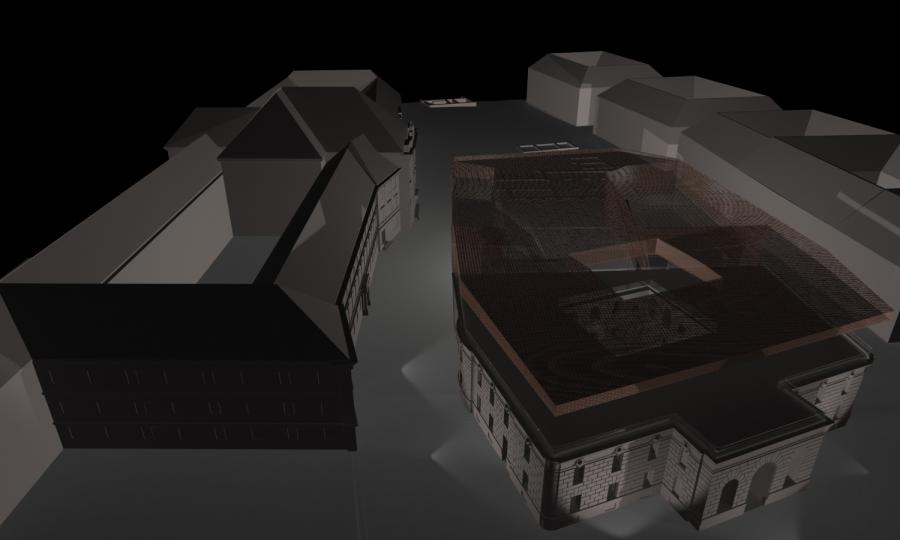
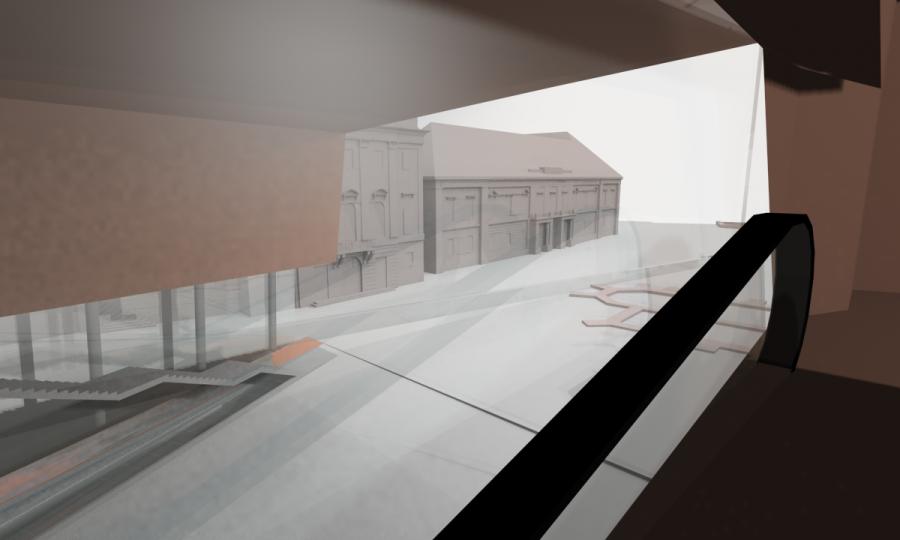
buda castle, disz ter 17. reconstruction
Our final conceptual elements included:
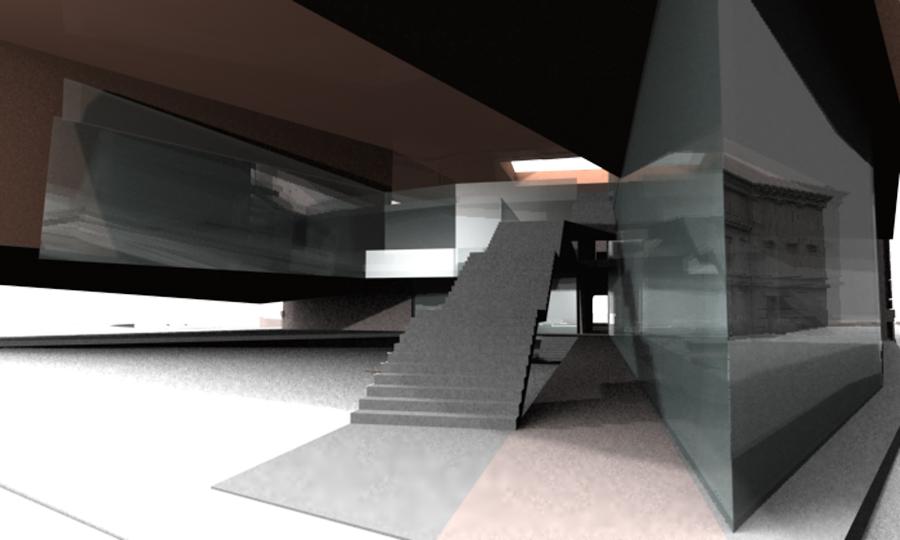
A lengthwise section of the building to exhibit a sequence of comman public spaces and paths
The raising of a new block that discourages competition between the 2 units and molds them together to compliment eachother - ultimatley acting as a whole
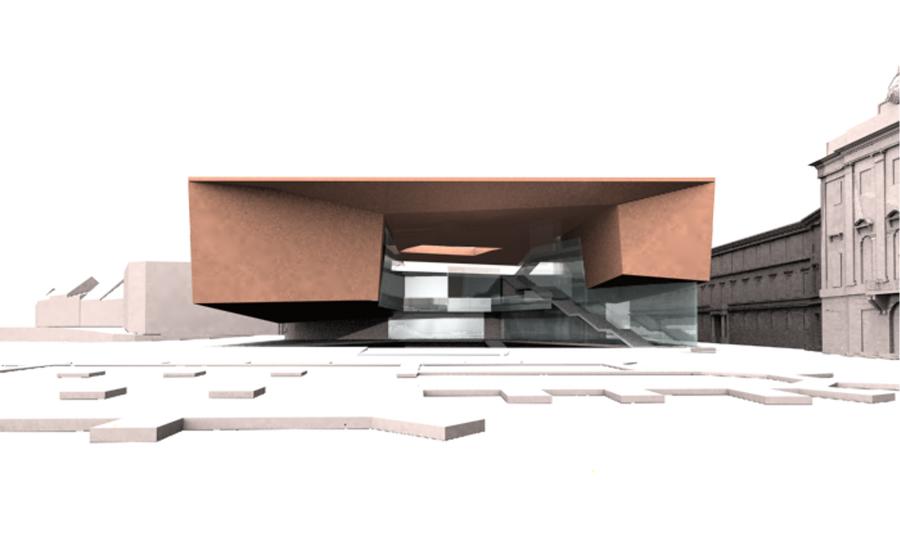
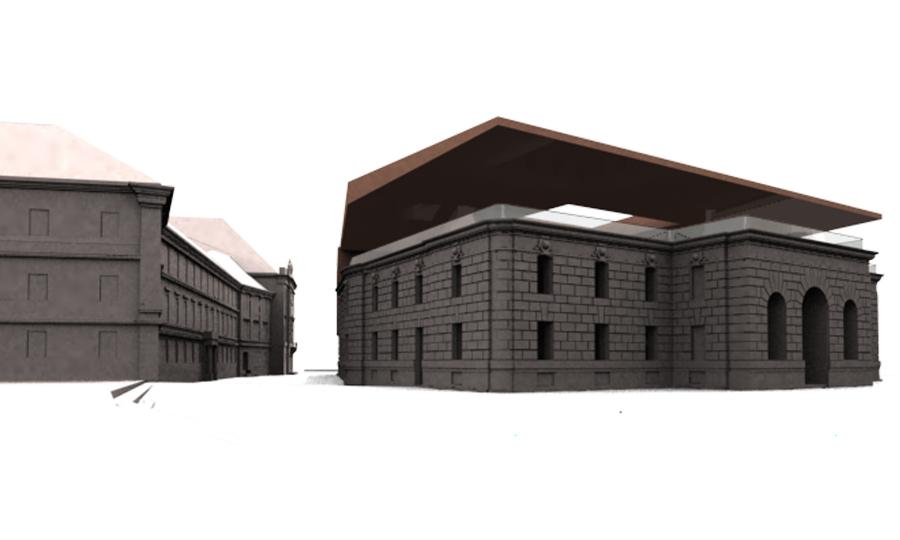
A roof overhanging as a new level above the extant acting as a solution to re-heighten the HP building to the original dimensions
Building
On the current site, we have introduced the building mass located between the Disz square and the St. George Square. It was an evident change made by this mass to the overall whole, while at the same time it maintained the most important existing properties: respectively it stretched its figure to close the entirety of both Squares. Why was it necessary to expand the building block, when the two Squares could have just as easily been separated by a wall? A particular geometry warrented this; the long axes of the Disz Square and St. George Square create a closed off square shape. A smaller block would not have closed off the extravagant view, and both Squares would have lost their intimate feel.
Character
The character of the new structure would be a siginificant decision. Exisiting, were two main characters. In itself it carried such modernity, much like every building, wanting to advance with new experiemtnal technologies, another part wanting to reveal its past. The values of the past cannot be shown by representing an earlier style in a ‘Walt Disney’ way, but rather through inspired artistic representations of the remains of the past and the past itself.
The success for remembering and being inspired by the past rests upon understanding it. The building envelopes of the Palace in Castle Hill and St. George Square were discovered upon excavation. The findings were dispersed throughout museums (where they could be showcased properly). In our plans, the discovered remains are each incorporated where a new dimension could develop for visitors to gain more knowledge of the site.
Renewal of Buildings Led by a Patrioric Command
The renewal of the building remains can only be a task for an architect. The renewal cannot completely erase the past of the building. The restoration of the monument also has many parts where reverting back to the original condition will not be a proper solution.
The roof top terrace was formerly a slab within the building. Ensuring the rainwater of the building is diverted, and creates an unparalleled view from Margit Island to the Basilica. Sunlight from above reaches the gallery space on the main level.
The firewall is the area where the Patriotic Command and the HM building meet. For the renewal, the elevations will become esteemed. The third phase of contruction will be the completing of the interior elevation of the agora.
In inner courtyard created a connection with the underground level and furthermore with the underground gallery spaces.
For the new addition, our fundamental concept was to understand that every piece of the HM building had been destroyed, and what remained was the footing of its pair, the HP building. Now the interpretation of the existing block was to be doubled. On one hand, this block remains as a memento of an old palace, on the other hand, it should be a sealed closed unit.
The competion requirements did not allow for the buildings original volumetric mass to be restored, whereas we also had to dismiss the style and the design principles of the existing building as a source for integrating the new addition. In such cases, there should always be a respectful desire to recreate original dimensions and ratios.
What we needed to consider was the relation between the fragments and the whole:
What fragments could be integrated into the homogenous fiber of the Castle District?
In which cases do the addition and the extant remnants act independantly and when do they act contextually?
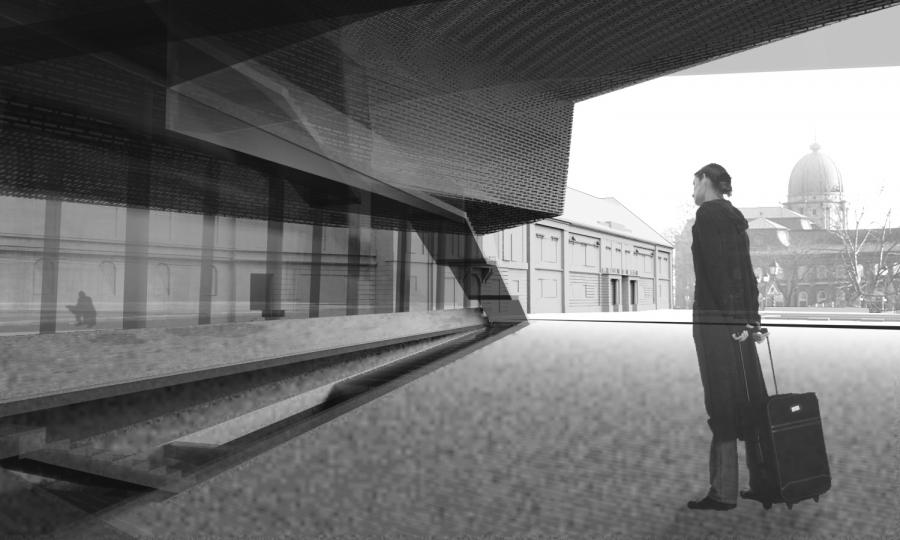
A major intention was to create horizontal throughways and complimentary spaces. The relationship between the two parts of the building is balanced by a fine proportion of building mass. The new addition is higher as it floats above ground while the existing block stands as a solid piece. The existing block utilizes the new addition for functional purposes, as well as a completion of its proportions. Together they appear as a monolith. The new addition cannot work on the existing buildings logic, however the two coincide as independant parts working as a whole – even with the soverign closed-geometry of the extant. The unique crystal-like form of the new addition gives a solution to the interior elements as well as the scale of the entire building. The building is constantly communication with its surroundings.
peter kis, gabor balazsa 2004
A lengthwise section of the building to exhibit a sequence of comman public spaces and paths
The raising of a new block that discourages competition between the 2 units and molds them together to compliment eachother - ultimatley acting as a whole
A roof overhanging as a new level above the extant acting as a solution to re-heighten the HP building to the original dimensions
Building
On the current site, we have introduced the building mass located between the Disz square and the St. George Square. It was an evident change made by this mass to the overall whole, while at the same time it maintained the most important existing properties: respectively it stretched its figure to close the entirety of both Squares. Why was it necessary to expand the building block, when the two Squares could have just as easily been separated by a wall? A particular geometry warrented this; the long axes of the Disz Square and St. George Square create a closed off square shape. A smaller block would not have closed off the extravagant view, and both Squares would have lost their intimate feel.
Character
The character of the new structure would be a siginificant decision. Exisiting, were two main characters. In itself it carried such modernity, much like every building, wanting to advance with new experiemtnal technologies, another part wanting to reveal its past. The values of the past cannot be shown by representing an earlier style in a ‘Walt Disney’ way, but rather through inspired artistic representations of the remains of the past and the past itself.
The success for remembering and being inspired by the past rests upon understanding it. The building envelopes of the Palace in Castle Hill and St. George Square were discovered upon excavation. The findings were dispersed throughout museums (where they could be showcased properly). In our plans, the discovered remains are each incorporated where a new dimension could develop for visitors to gain more knowledge of the site.
Renewal of Buildings Led by a Patrioric Command
The renewal of the building remains can only be a task for an architect. The renewal cannot completely erase the past of the building. The restoration of the monument also has many parts where reverting back to the original condition will not be a proper solution.
The roof top terrace was formerly a slab within the building. Ensuring the rainwater of the building is diverted, and creates an unparalleled view from Margit Island to the Basilica. Sunlight from above reaches the gallery space on the main level.
The firewall is the area where the Patriotic Command and the HM building meet. For the renewal, the elevations will become esteemed. The third phase of contruction will be the completing of the interior elevation of the agora.
In inner courtyard created a connection with the underground level and furthermore with the underground gallery spaces.
For the new addition, our fundamental concept was to understand that every piece of the HM building had been destroyed, and what remained was the footing of its pair, the HP building. Now the interpretation of the existing block was to be doubled. On one hand, this block remains as a memento of an old palace, on the other hand, it should be a sealed closed unit.
The competion requirements did not allow for the buildings original volumetric mass to be restored, whereas we also had to dismiss the style and the design principles of the existing building as a source for integrating the new addition. In such cases, there should always be a respectful desire to recreate original dimensions and ratios.
What we needed to consider was the relation between the fragments and the whole:
What fragments could be integrated into the homogenous fiber of the Castle District?
In which cases do the addition and the extant remnants act independantly and when do they act contextually?
A major intention was to create horizontal throughways and complimentary spaces. The relationship between the two parts of the building is balanced by a fine proportion of building mass. The new addition is higher as it floats above ground while the existing block stands as a solid piece. The existing block utilizes the new addition for functional purposes, as well as a completion of its proportions. Together they appear as a monolith. The new addition cannot work on the existing buildings logic, however the two coincide as independant parts working as a whole – even with the soverign closed-geometry of the extant. The unique crystal-like form of the new addition gives a solution to the interior elements as well as the scale of the entire building. The building is constantly communication with its surroundings.
peter kis, gabor balazsa 2004